

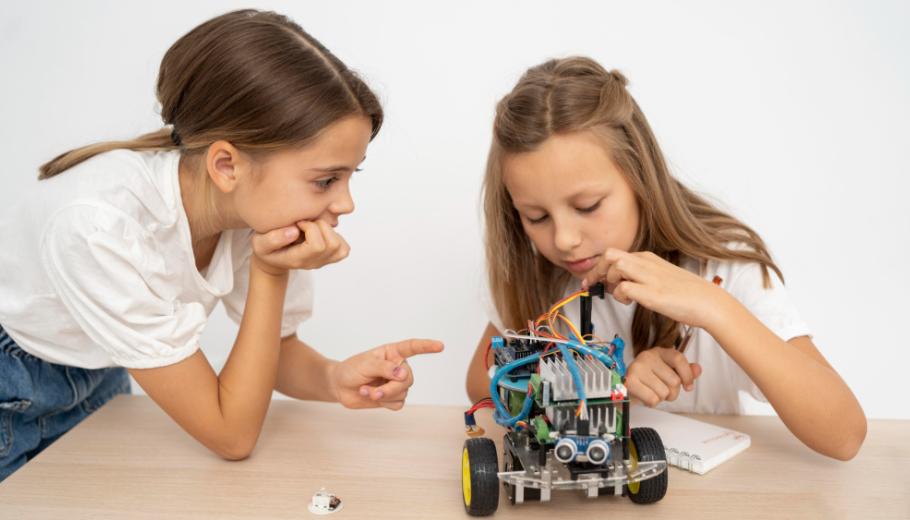


On the International Day of Women and Girls in Science, we want to strengthen projects like those at the Espai Polivalent, as it generates equal opportunities between boys and girls, so that today’s young women will be the scientists of tomorrow.
We live in a world where girls have been relegated to games like dolls or kitchens and boys to cars, Legos or science. Therefore, it is no coincidence that once they grow up, women dedicate themselves to professions linked to care, while men are in the majority in jobs known as STEM, science, technology, engineering and mathematics, in their acronyms in English.
Therefore, within the framework of the Day of Women, Girls and Science, which is celebrated this February 11, we want to emphasize the fact that an educational model is needed where girls have the same opportunities to access games and activities linked to science, technology or innovation so that today's young women can become the scientists of tomorrow.
This is what is pursued in places like the Espai Polivalent de l'Hospitalet de Llobregat, a Càritas service managed by Suara Cooperativa, where innovation has just landed as a tool to promote social cohesion and equality.
This service, with more than 15 years of life, was born as a project that is built from the community and with the community to promote social cohesion with a space of proximity and reference in the neighborhood, which has the capacity to welcome, listen and accompany diverse people. To achieve this objective, leisure and cultural activities for all ages are encouraged, as well as outings for walks on Saturdays.
Innovation projects
In this context, several innovation pilot tests have been deployed in the Espai Polivalent, aimed at strengthening social cohesion and equal opportunities. These are based on a clear premise: innovation must be a useful, understandable and accessible tool for the entire community, regardless of gender, age, origin or socioeconomic situation.

Along these lines, the Espai Polivalent has explored the use of immersive technologies as a resource for learning, discovery and participation. Experiences with virtual reality glasses and the immersive room have been tested, which favors experiential methodologies that stimulate curiosity, bonding and active participation in an inclusive and safe environment.
In a complementary way, training actions linked to the use of 3D printers have been promoted, aimed at professionals, with the aim of providing the space with new tools and alternatives for community activity. These initiatives allow to expand the range of service activities for children and their families and highlight an essential aspect of the project: the involvement of volunteers linked to the Multipurpose Space, who contribute to making possible an innovation rooted in the territory and built from the community around this service.
Finally, the use of educational robotics (Lego Education) has been incorporated as a pedagogical resource to promote key learning in childhood. Through manipulative and game dynamics, cognitive development is worked on through logical thinking and problem solving, as well as a beginning of computational thinking without screens. At the same time, social and emotional skills (cooperation, communication and frustration management) are reinforced and creativity and imagination are boosted. All this, with a view to equity that guarantees access and participation in equal opportunities for girls and boys.
This action is part of Suara Cooperativa's commitment to social innovation, understood as a tool at the service of people to reduce social, economic and digital gaps. On a date like the International Day of Women and Girls in Science, this commitment takes on special relevance: real access to technology and innovation from childhood with equal opportunities between boys and girls is key so that today's girls can become the scientists and engineers of tomorrow.


