

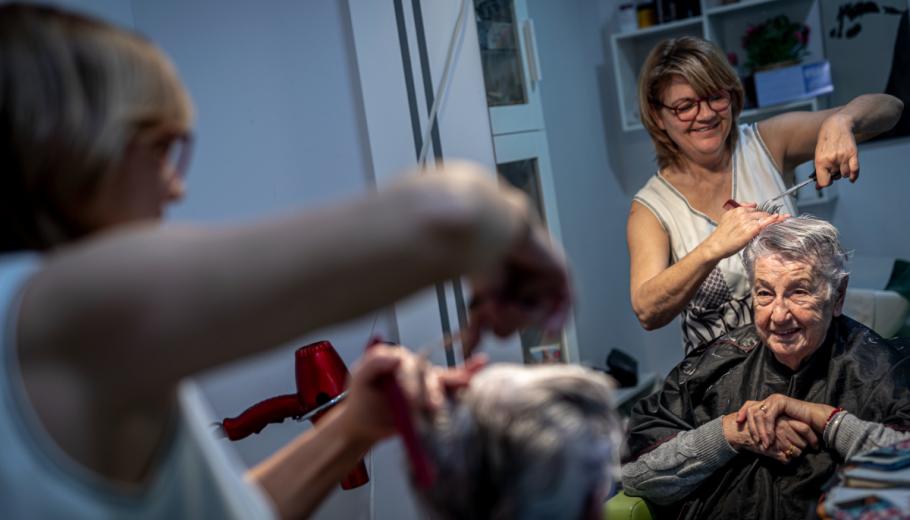


Women are the majority in personal care services, a sector that is invisible despite its relevance for society as a whole
The elderly and/or dependents, children, adolescents or adults in a situation of vulnerability, homelessness or at risk of social exclusion. All of these people have one thing in common: that the people who accompany them work in professions linked to the third sector, care and attention, such as domestic workers, social education, social work or psychology.
In addition, these professions have another common denominator: the majority of workers are women. In fact, around 400,000 women work in the third sector in Spain, which represents nearly 75% of the jobs it generates, according to a study by the Third Sector Employment Observatory. This means that around 5% of the jobs developed by women are in the third sector, which is the fifth sector that creates the most female employment. At Suara Cooperativa we know this reality very well: 88% of our workforce are women, according to data from our latest Sustainability Report.
Within the third sector, the gaps themselves already exist: 26% of women work in part-time jobs compared to 19% of men; at the same time, they earn around 19% less than their colleagues, according to the same study.
A reality that although increases if we compare the working conditions of people in the third sector with those of other work areas. Beyond the precariousness that the high number of part-time contracts entails, professionals in this field also have lower salaries than other experts with similar training and responsibilities in the public and/or private sectors.
However, our role is essential, as we serve 2 million people in Catalonia, around a quarter of the population; and we generate 3,874 million euros, close to 2% of GDP, according to a study by the Taula del Tercer Sector.
Surely, the fact that, traditionally, invisibly and without remuneration, mothers, daughters and grandmothers have assumed the tasks of emotional and physical care, as well as raising family members. However, at a time when these tasks have become professionalized, we must now make them visible and recognize them as they deserve: with adequate salaries that allow women in the sector to build vital and work projects.
Therefore, this March 8, International Women's Day, we want to put the spotlight on women who work in the care sector and illuminate their transcendental work through their voices. With this aim in mind, from March 3 to 7 we will publish a video every day with the testimony of a worker from Suara Cooperativa. Each of them will talk about the importance of the role of care in their services (for the elderly, children and people in situations of homelessness) and the key role that women play in this.
Among the women who will speak are witnesses from the Home Care Service (SAD), which currently employs around 68,000 people, of whom 3,800 work at Suara Cooperativa. Their work, however, will be even more essential in the coming years due to the aging of the population. For this reason, around 33,500 more will be needed in 2050. However, within the care sector, it is one of the most invisible and precarious profiles. We will also see how the care sector is vital for children who are victims of sexual violence and in supporting people in situations of homelessness.
Given this context, within the framework of the campaign we will also show how, from cooperativism, we also contribute to transforming the reality of working women and taking care of them. Therefore, in the face of this reality, cooperatives train and promote the growth of working women so that they can also build a work and life project on equal terms with their male colleagues.
A good example of this is that we promote female leadership and, for this reason, women occupy 54.66% of the management positions in cooperatives, according to the annual Barometer of the Federation of Cooperatives of Catalonia. However, according to a statement from the Catalan government, in 2024 women occupied only 33.4% of management positions, a figure well below the cooperative world.
Do you want to know more about the importance of the role of care, the essential role of women in sustaining our societies or how, from cooperativism, we transform the reality of our workers? Stay tuned in the coming days on our social networks.


