

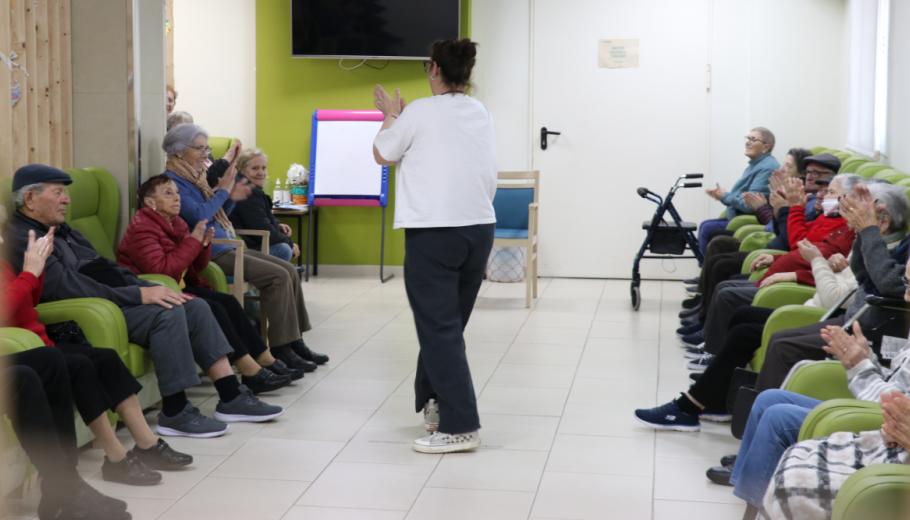


At Suara Cooperativa we put care work at the center to give it the value, professionalism and dignity it deserves.
Traditionally, care has fallen to women and has been made invisible. Surely, for this reason, currently the professions linked to care continue to be eminently feminine, little recognized and invisible.
However, care is the basis that sustains our societies and is essential for the care and support of elderly people, in situations of dependence and/or vulnerability. Therefore, this March 8, International Women's Day, at Suara Cooperativa we put the focus on women who work in professions linked to care such as domestic workers, social educators, social workers or psychologists, among others.
“As a cooperative, our mission is to put care work at the center to give it the value, professionalism and dignity it deserves. For this reason, our activity is based on the professionalization of care, transforming roles traditionally assigned to the private sphere into jobs with solid labor rights, training and social visibility”, defends Rosa Castillo, Participation technician and member of the Governing Council of Suara Cooperativa.
Home care services
Currently, in Catalonia, 19.5% of the population is 65 years old or older, a figure that will climb to 30% by 2050. This will translate into the Home Care Service (SAD) requiring 33,500 more professionals in 24 years to respond to the aging population.
Currently, Suara Cooperativa employs more than 3,800 people in SADs, an essential service for the care of the elderly and/or dependent people. One of these workers is Yolanda Pérez, who says that it is a very rewarding job. “It is a sector that is not valued, but when I enter the home and see the person who welcomes me with a smile, I completely forget about the rest”, says Pérez.
One characteristic of her job is that each person is different and, therefore, it must adapt to them, to their particularities, needs and realities. “My job goes further. You go to the home and you often find elderly people who are very alone, whose family, for whatever reason, cannot go to see them as they would like and, then, these people do need someone to go to their home to talk, to listen to them”, she argues.
An essential, but precarious sector
People who work in the third sector are essential for our societies. In Catalonia, for example, we serve around 2 million people, which represents almost a quarter of the population, according to a study by the Taula del Tercer Sector. In addition, we contribute 3,874 million euros to the GDP, which represents 2% of it. However, salaries are lower compared to other professionals with the same levels of education or responsibilities in the public or private sector.
For its part, the Observatorio del Empleo del Tercer Sector details that in Spain around 400,000 women work in the third sector, which represents 75% of the jobs it generates. This makes it the fifth activity with the most female employment. Suara Cooperativa, clearly, also has a female face. In our organization, we employ around 6,000 people, of whom 88% are women.
Faced with this situation, Júlia Hernández, director of the Sostre 360º Maresme service where we empower young people in a situation of homelessness so that they have greater autonomy, demands: “The visibility of our vital task for society as a whole and an improvement in the conditions of the third sector to be able to build decent vital and work projects”.
At the Barnahús in Tortosa, where we care for children and adolescents who are victims of sexual violence, 71% of the workers are women. This service is based on social and health integration so that in a safe and friendly environment different experts from fields such as social education, social work, justice or medicine can care for the victim in the same space. In this, a change of model is also promoted because the caregiver is also placed at the center of the process - assures Patricia Benet, director of the service.
“We recognize the value of care, support and a gender perspective as pillars of the protection system. Caring is not just about attending to physical needs, it is about listening, supporting, looking with respect and dignity”, defends Benet.
Dignifying the care professions
At Suara Cooperativa we are aware of the importance of dignifying the professions linked to care and also of supporting our workers so that they can grow professionally within the organization.
“But caring also means caring for those who care. At Suara Cooperativa, we support professionals —mostly women— so that they can grow, train and lead their work and life projects,” says Benet.
Pérez, for example, was a home helper and, through the Suara Campus, she has received a course to become a SAD family worker. “It is a step forward for me, for my training, an illusion too, to learn, experience new situations, a change in work that always goes well,” says Pérez, who adds: “This is obviously empowering.”
In a world where technology is advancing rapidly, another way to dignify the profession is to put innovation at the service of people so that no one is left behind and to break the existing social, economic and digital gaps. An example of this is the SAD in Hospitalet de Llobregat where we have carried out pilot tests with virtual reality and robotics in the homes of people receiving care.
“Technology can make our work easier, but we are essential domestic workers. The care and attention of people requires a bond”, emphasizes Encarni Martín, who adds: “This March 8th we demand the visibility and dignity of our work. For this reason, technology must be a support for our functions to streamline our tasks and improve the quality of our service”.
Breaking gaps from cooperativism
One of the main demands of this March 8th is to break with the glass ceilings and the difficulties that women encounter in reaching managerial positions. In Catalonia, according to a government statement, only 33% of leadership positions are occupied by women.
A reality that is very different in cooperativism where women head 54.46% of the management of our organizations. Therefore, we are an example to follow in this necessary social transformation. A figure that is even higher at Suara Cooperativa as shown by the composition of our Governing Council, made up of eight women and one man, according to which the General Assembly has democratically chosen one person, one vote.
“We are an organization made up mostly of women. This is not just a statistical fact, it is our identity; and in an organization like this, female leadership cannot be an exception. It must be our leadership style”, points out Castillo. In order to achieve this challenge - points out this professional - at Suara Cooperativa we make available “to professionals, participation mechanisms and work-life balance policies that allow for healthy work environments”.
In a world where care has always been in the background and in the shadows, this 8M, International Women's Day, we demand that care be placed at the center of our societies, since it is essential to sustain them. For this reason, we also demand the dignification and professionalization of the jobs linked to care, which we, mainly women, carry out. Suara Cooperativa, women who decide to take care of people. And what do you decide?


