

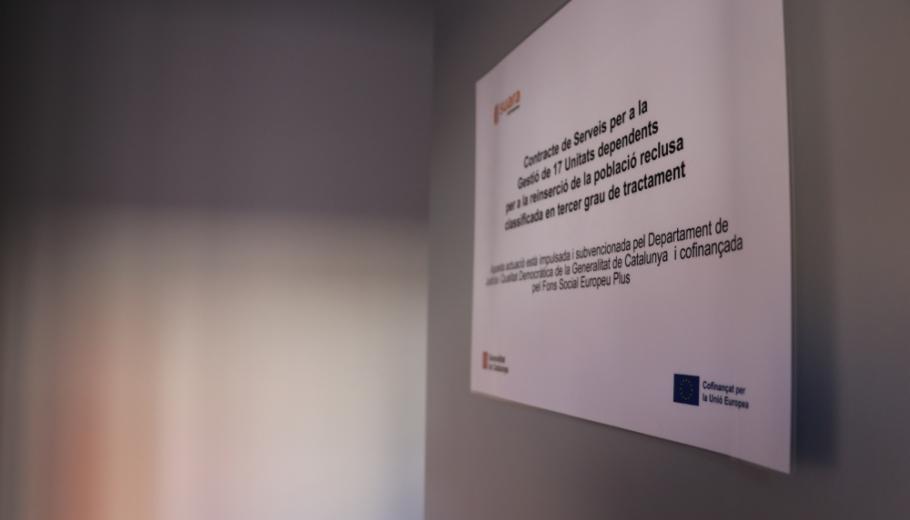


A large part of the prison population comes from situations of extreme vulnerability. Within the framework of the World Day of Social Justice, we focus on how, from the Dependent Units, we accompany these people in the construction of a solid social and labor project, capable of opening doors to real opportunities that they often had not had until now.
On February 20, the World Day of Social Justice reminds us of the importance of building more just, inclusive and cohesive societies, where equal opportunities are a tangible reality. Social justice is not only an inspiring principle, but an everyday practice that is embodied in public policies, social projects and community alliances capable of transforming life trajectories and strengthening coexistence.
In this context, in April 2024, Suara Cooperativa assumed the management of two new Dependent Units in Martorell and Terrassa, adding them to the one in Alt Empordà, which we have already managed since 2018. These resources, owned by the Department of Justice of the Generalitat de Catalunya, are part of a contract co-financed by the European Social Fund through the Employment Service of Catalonia.
The Dependent Units welcome people who are in advanced stages of serving their sentence and who are beginning their progressive return to the community. The objective is clear: to guarantee consistent, responsible and sustainable social and labor insertion processes over time.
The data shows the relevance of these resources. Many of the people deprived of their liberty have experienced contexts marked by economic precariousness, situations of violence, complex migratory processes or addictions. Therefore, it is no coincidence that nearly 42% of the prison population is convicted of crimes against property, according to data from the Department of Justice from 2024.
However, there are also reasons for hope. According to a report from the same department (2023), 80% of people who have been through a prison do not reoffend. This figure rises to 90% among those who have accessed semi-liberty regimes and have received support in services such as the Dependent Units. We are therefore talking about people who can consolidate change processes thanks to continuous professional support that allows them to plan a life in freedom.
How we support the people we serve
From the Dependent Units we work on job insertion as a backbone, together with the promotion of personal autonomy, the strengthening of family and social ties, the healthy management of free time and the processes of breaking the habit of consumption, among other specific support.
This work is developed from a deeply individualized perspective, adapted to the rhythms and needs of each person, based on the conviction that effective reintegration requires time, trust and sustained support.
One of the pillars of the model is the prevention of recidivism, addressed through person-centered care and rigorous monitoring. This process is possible thanks to the coordinated work of Suara Cooperativa's multidisciplinary professional teams, in close collaboration with the specialized monitoring professionals of the penitentiary centers and with a constant connection with the territory.
Employment integration is reinforced by networking with the local community, the business community and insertion companies, generating real employment opportunities and consolidating itineraries that allow the acquisition of habits, skills and responsibilities. This comprehensive approach favors dignified and sustained employment, a key element for full and stable reintegration.
Beyond access to work, support focuses on essential aspects such as personal relationships, beliefs, attitudes and forms of communication, worked on both the individual and collective levels. All of this facilitates the incorporation of new life habits and a dignified, responsible and future-oriented exit.
The Dependent Justice Units are a clear example of how social justice is built from institutional cooperation, professional commitment and community work. Investing in support, autonomy and integration not only transforms lives - it also contributes to a safer, more cohesive society with more opportunities for everyone.
Esther Olivares Juárez
Directorate of Dependent Justice Units of Martorell - Terrassa


