
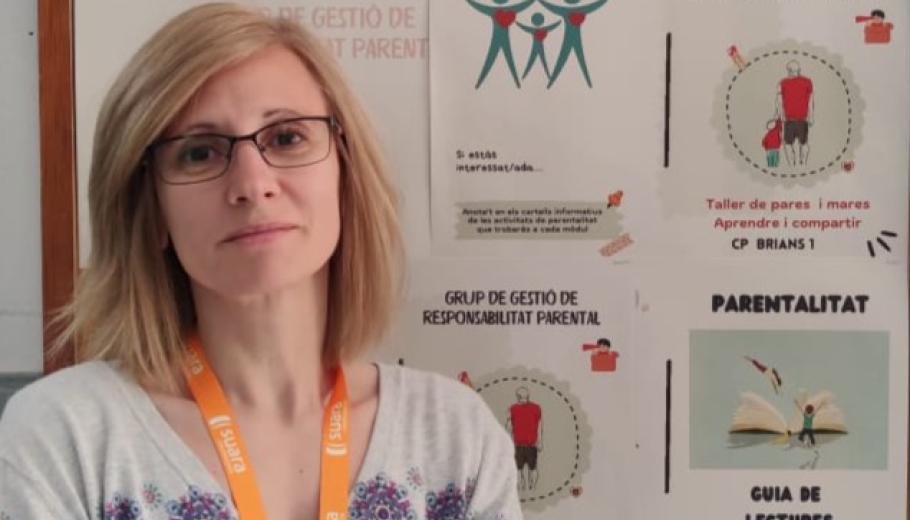


On the occasion of International Family Day, the intercultural mediator of Suara Cooperativa, Daniela Trofin, explains the importance of maintaining family ties during a stay in prison and how this support is worked on from the Brians 1 center.
"Families, inequalities and child well-being". This is the motto that the United Nations (UN) has chosen for this May 15, 2026: International Day of Families. With this message, the UN wants to raise awareness about how economic inequality can wreak havoc on families and children. Even separating them for a time, as is the case for those parents who have been deprived of their liberty. There are nearly 8,500 people in Catalan prisons, half of whom have sons or daughters. In many cases, they come from situations of vulnerability that have pushed them to commit a crime to cover the basic needs of their family. Therefore, it is no coincidence that the majority of the Catalan prison population, 41.81%, is convicted of crimes of theft or against property (followed by crimes against collective safety and public health); or that 80% do not reoffend.
As a collaborator of the parental responsibility group in Brians 1, Daniela Trofin, from Suara Cooperativa, works to facilitate the exercise of parenthood and the maintenance of family ties in the prison environment.
What is the mission of this group?
The mission of the Parental Responsibility Group is to ensure that admission to prison does not mean a rupture of family ties. We work from a multidisciplinary perspective, integrating professionals from social work, social education, librarianship, psychology and intercultural mediation, among others, to accompany parents in the exercise of their function. Our objective is twofold: on the one hand, to preserve the emotional bond and the emotional presence of the father or mother in the lives of their children; on the other, to promote parental responsibility. We want the inmate, despite the physical distance, to remain involved in the education and well-being of the minors, assuming their obligations and understanding that their role as a reference continues to be essential for the development of their children.
Within this group, Daniela, what are your functions?
My function as an intercultural mediator is to facilitate communication and understanding between the penitentiary system and the inmates, especially with groups from Eastern Europe, Central Europe and Latin America. My task is to accompany them in the exploration and evolution of their parenting models. We work together to incorporate new tools of conscious education and methods of positive conflict resolution, adapting them to the reality of each family. The value of mediation consists precisely in putting their cultural identity into dialogue with strategies that promote good treatment, active listening and a full emotional presence. We do not seek to replace their references, but to enrich them: to raise awareness about the importance of a bond based on affection and mutual respect. In addition, we dynamize the group's activities by ensuring that the cultural diversity of each home strengthens its educational role and the connection with its sons and daughters.
How many people do you currently accompany?
Brians 1 is a preventive center and this implies a high turnover of people. The group is a very dynamic space, where the number of participants constantly fluctuates. Often, inmates move to other centers when they receive a final sentence or are released while the project is underway. For this reason, we carry out constant dissemination and awareness-raising work within the center to make the group known to newcomers. Our goal is for any parent, from the first moment of admission, to know that they have this support space.
And what activities do you do?
Our work includes a range of transversal activities that strengthen the bond and the educational role. We have promoted the storytelling project and the creation of digital Christmas postcards to maintain the emotional bond. We have also carried out the 'Family Cinema', where inmates got involved by preparing personalized tickets for their sons and daughters, and mindfulness sessions to work on emotional balance. On the other hand, we organize talks by writers specializing in stages such as adolescence and we collaborate with the center's library to bring bibliography on parenting and parenting to interested people.
When a father or mother enters a penitentiary center, how does this affect their relationship with their family, what fears may arise in this first moment?
Each case is unique, but the central concern is usually how to communicate the absence. While many parents opt for silence for fear of judgment and guilt, on other occasions we find a low perception of the real impact that the situation of admission to the penitentiary has on the child's development. Added to this scenario are deep fears such as the loss of the parental reference or social stigmatization. From the group, we work to overcome these limitations and recommend betting on the truth adapted to the age, since secrecy generates insecurity in the long term. To do this, we accompany them in managing this moment and offer them communication resources and specific literature to address their reality in an honest and healthy way.

And once this first phase has passed?
Once the initial awareness phase has been overcome, we move on to comprehensive support. All our interventions, from follow-up meetings to group activities, have as a priority the maintenance and strengthening of the family bond, focusing on parental co-responsibility despite the distance. This task is materialized especially in the emotional management of the meetings: we work on the pre-visit to adjust expectations, direct contact to promote positive communication, and the post-visit to process the absence of the return to the module. Our purpose is to guarantee the quality and stability of the bond, offering a space for reflection on the responsibility of each parent in family life and ensuring, above all, the well-being of the children.
How do you do it during meetings without activities, only spaces with the family?
In the family communications and visits scheduled at the center, our goal is to humanize the environment to facilitate a space for coexistence that is as natural as possible. We have enabled specific areas with recreational resources selected by age groups, which operate through an organized delivery circuit. This arrangement allows the child to enjoy a safe and quiet play space, while the adults have the necessary break to have conversations. In this way, we facilitate the father or mother to assume their role and ensure the well-being of their child, minimizing the emotional impact of the prison context during all the meeting spaces with the family.
Do you accompany children?
Although our focus is on the inmate, we also accompany families and children. During the hours of the meetings, knowing their stories beforehand can create an immediate bond of proximity. This personalized recognition generates great tranquility for couples and children. Knowing who we are and how we work helps to see that their relatives are accompanied by professionals who ensure their well-being. This makes the moment of farewell, despite being emotional, much more serene.
In the end, is it about whether, regardless of the situation, there will still be a family?
Exactly. The goal is that physical distance does not become an emotional absence or a renunciation of educational responsibility. We work so that parents maintain their active role through all available channels: from face-to-face and telephone communications to activities that generate a symbolic presence in the children's daily lives. An example of this is the birthday details: through the collaboration with the Plastic Arts group, symbolic cakes are prepared for congratulatory photographs to send home. These gestures remind children that, despite the separation, their father or mother is present and has them in their thoughts. Ultimately, we aim for this stage of confinement to be only a physical break, but for the emotional bond and parental commitment to continue to grow and strengthen.
This May 15th is International Day of Families. Often, when we think of a family, this is not the prototype that comes to mind at first, but why is it important to give them an answer so that they can maintain the family bond?
It is fundamental because the family is a powerful anchor for reintegration. Knowing that there is someone outside who is waiting for you, who needs you and who counts on you, gives a sense of purpose and reduces recidivism. The family bond is not just moral support; it is the engine that drives personal change. On the other hand, from the perspective of childhood, it is a right and an essential necessity for its development. Even if the father or mother is not physically there momentarily, keeping their figure and reference alive is key to the emotional stability of the children. Giving a response to these families, beyond the conventional prototype, is recognizing that the emotional bond is what really sustains us as a society and that, despite the walls, the parental function can and must continue to be exercised with dignity.