

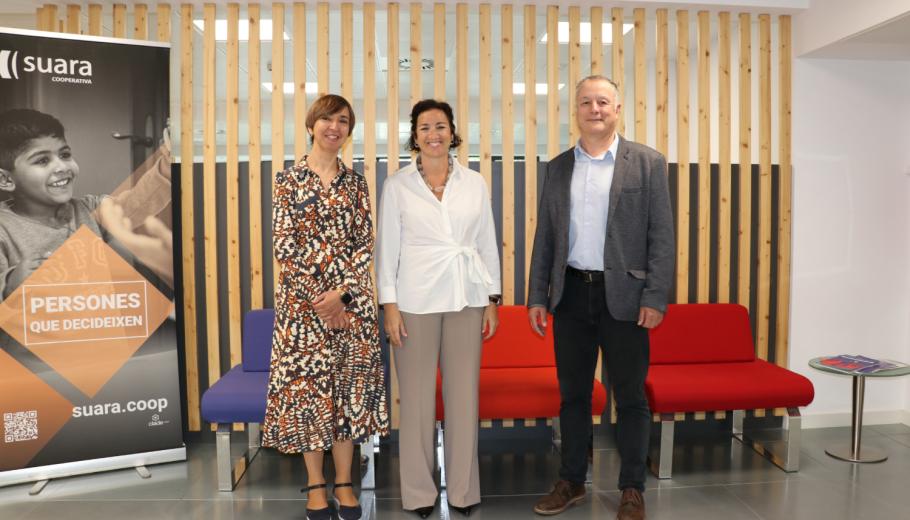


The Minister of Economy and Finance, Alícia Romero, visited our headquarters in Barcelona to learn about our model of care for people and some of the projects we are promoting to move towards more sustainable, personalised and people-centred social services.
The visit began with an institutional welcome and a presentation of our facilities and the Social Digital Lab, the space from which we promote projects for social and digital transformation to respond to the sector’s new challenges.
During the visit, the Minister, accompanied by Cristina González Buil, Head of Cabinet, toured different areas of our headquarters, including the CVI and the Immersive Reality Room, where she was able to learn first-hand about several initiatives that form part of this model. These include assistive robotics projects aimed at supporting older people living alone or in residential settings; Casal TV, an initiative designed to help reduce unwanted loneliness; and Llars Connectades, which incorporates sensors and home-based technology to promote personal autonomy.
As part of the visit, the Minister of Economy and Finance, Alícia Romero, has stressed that “The Minister of Economy and Finance, Alícia Romero, highlighted Suara Cooperativa’s innovative model of person-centred care, which puts social and technological innovation at the service of wellbeing". She also expressed the need to move towards a more sustainable care model.
The day also included a working meeting with our co-general management team, in which we shared with the Minister some of the sector’s main challenges and the need to promote legislative and funding changes that would make it possible to advance in the technological transformation of social services.
In this context, our co-general director, Laura Peracaula, stated that “the new model we propose at Suara is committed to deinstitutionalisation. We are seeking a model that is economically sustainable for the public administration and for families, and dignified for professionals. And we are convinced that this requires, on the one hand, technological innovation and, on the other, a social services system on a par with the healthcare system.”
We also highlighted the need to adapt the current funding model to make this transformation viable. As Peracaula explained, “the current service-hour model does not allow for the introduction of technological improvements in care for people. That is why we are asking the administration to support us on this path by adapting the funding model.”
This visit allowed us to share with the Minister our vision for the present and future of care services for people, as well as our commitment to a more innovative, accessible and sustainable model, in which technology is placed at the service of wellbeing, personal autonomy and the quality of care.


