

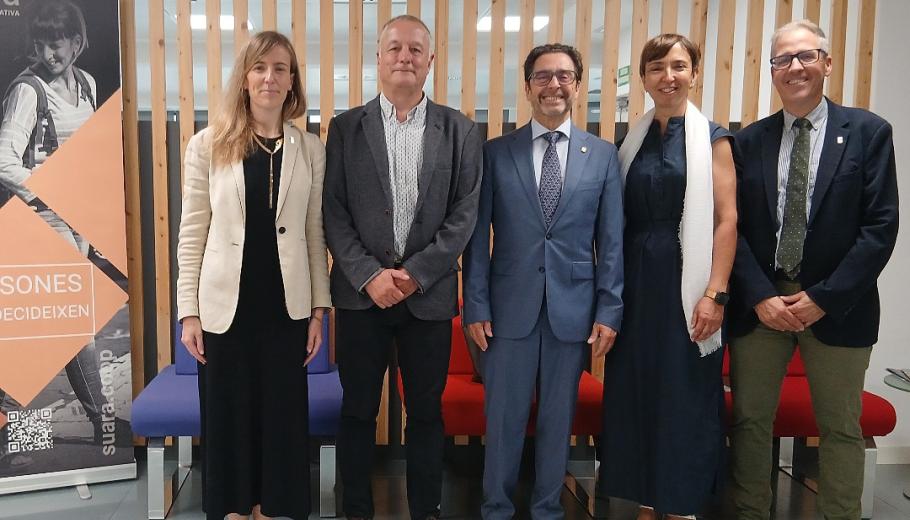


The Rector of the University of Barcelona, Joan Guàrdia, has visited Suara’s headquarters, where he learned about the Social Digital Lab and the main projects promoted by the cooperative.
The visit by the Rector of the University of Barcelona, Joan Guàrdia, included a tour of different areas of Suara’s headquarters to gain first-hand insight into its activity and the projects the cooperative develops in the field of transforming care services for people.
The Rector was accompanied by Guillem Íñiguez, Director General of the University of Barcelona’s Institute for Continuing Education (IL3), and Victòria Alsina, Director of Strategy at IL3. The delegation was welcomed by Laura Peracaula and Tomàs Llompart, co-directors of Suara Cooperative.
The delegation learned about the Social Digital Lab, Suara Cooperative’s social innovation lab, which promotes spaces for intercooperation between universities, public administrations, citizens, technology companies, and research centres to design, create, and implement responses to major social challenges.
From this space, the transformation of services is driven through co-creation and the use of digital technologies, with the aim of making them more accessible, efficient, and sustainable, and improving people’s quality of life.
Among the projects developed at the Social Digital Lab are initiatives that incorporate immersive virtual reality to improve mental health and emotional well-being, connected home solutions with sensor technology, smart watches and voice assistants in home care, as well as robotics applications in homes and care facilities for older people, among others. As a result of this work, 40 projects, 12 pilots, and 12 hackathons have been launched in 2025.
Throughout the meeting, the Rector positively valued the projects he was able to learn about first-hand and highlighted that Suara “does something extraordinarily positive and interesting, which is combining the need to provide responses suited to the times we live in with people’s needs, a combination with highly relevant intellectual and scientific dimensions.”
He also recalled the role of the university as an institution dedicated to the generation and transmission of knowledge with a strong public service vocation, highlighting in this context the collaboration with entities such as Suara to address challenges with scientific and social impact.
Innovation at the service of people
Another space visited by the delegation was the Independent Living Centre (CVI), a supported housing facility that develops solutions to promote the autonomy of people in situations of dependency and enable them to carry out their daily lives at home. It is also a space where professionals in the sector can receive training in real environments.
The immersive reality room at Suara Cooperative was the final stop of the visit, where they experienced this technology with the potential to foster social inclusion, provide support in mental health, and open up new opportunities for the future.
The visit allowed for a tour of the main spaces at Suara’s headquarters linked to innovation and the transformation of care services, in a day of dialogue and exchange of perspectives on current social challenges.


