

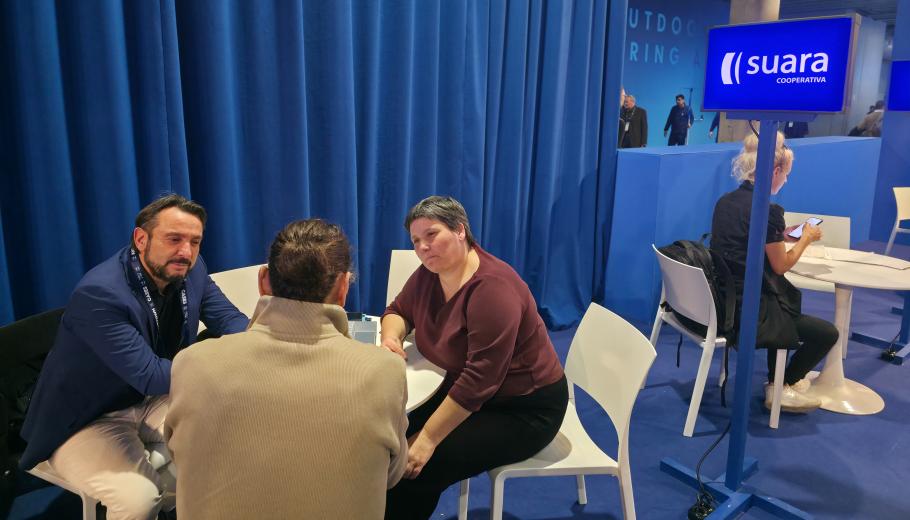


Suara Cooperativa’s Social Digital Lab took part in ISE (Integrated Systems Europe) in Barcelona, within ACCIÓ’s Open Innovation Challenges area, where it presented a challenge aimed at driving meaningful, open, and inclusive educational digitalisation, placing students and teachers at the centre.
In a context where classroom technology has often translated into closed devices and applications, Suara argues that this model does not guarantee a deep or equitable educational transformation. The challenge seeks to open a new path: a form of digitalisation that improves learning and wellbeing, and turns technology into a living, creative, and accessible tool.
In the words of Susana Mon Benabarre, a reference for Distributed Innovation Lleida, the challenge is to move towards an “educational digitalisation that improves learning and wellbeing, reduces the digital divide, and builds community, guided by ethical criteria.”
Co-creating digital experiences in the classroom
The goal is to identify solutions that enable teachers and students to co-create digital classroom experiences in an open, critical, and inclusive way—moving beyond closed tools and enabling personalisation, experimentation, and real connectivity between the educational community and technology.
We are looking for proposals that:
- Enable teachers to design, adapt, and share digital resources and experiences according to their context, without needing advanced technical expertise.
- Give students room to choose, experiment, and actively build their own learning.
- Foster genuine collaboration among teachers, students, and the wider educational community, beyond simply consuming technology.
- Ensure accessibility, inclusion, and digital equity, including in settings with limited connectivity or older devices.
- Include privacy, security, and digital wellbeing criteria, especially when dealing with minors’ data or the use of artificial intelligence.
- Integrate with the existing educational ecosystem (LMS, platforms, and digital learning environments) through open standards (LTI, xAPI, etc.).
Specific challenges to address
The challenge raises key questions such as:
- How can we empower teachers to create more open and participatory digital learning experiences without requiring advanced technical skills?
- How can we make students’ learning processes visible by connecting reflection, experimentation, and formative assessment?
- How can we design inclusive digital environments that do not exclude due to access, ability, or socio-economic context?
- How can digital technology strengthen the educational community instead of isolating it?
Expected impact
The initiative aims to generate tangible, transferable impact:
- Transforming the teaching role: from transmitter to designer of learning experiences.
- Empowering students as creators, not only digital consumers.
- Improving digital wellbeing and classroom climate.
- Producing knowledge that can be replicated in other schools and educational settings.
- Contributing to the debate on meaningful educational digitalisation and ethical criteria.
On 4 February, during ISE, the Social Digital Lab team met with companies and innovative teams to explore proposals that respond to the challenge, with special attention to privacy and security when handling minors’ data. In this process, we received around 20 proposals from different companies, which we are now analysing to assess fit and next steps.
Suara Cooperativa will continue sharing learnings and exploring alliances to move towards a more human, open, and inclusive digital education.


