

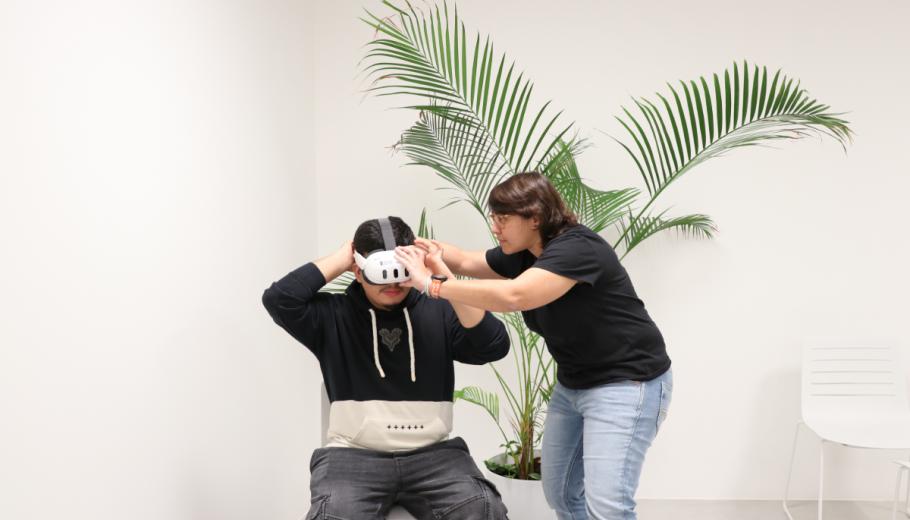


Suara is organizing a hackathon with professionals from the cooperative, as well as civil entities, to create different virtual reality experiences to put yourself under the skin of a victim of LGBTI-phobia.
Far from going backwards, LGBTI-phobia is a very present scourge in our societies that is growing again, especially among the younger population. This, in large part, is a consequence of the irruption of the extreme right and hate speech in our institutions.
“We are in a reactionary wave and facing an ultra-right that is coming very incisively towards people's rights,” says Ferran Poca, president of the LGTBIQ+ Chamber of Commerce and Pride of Barcelona in an interview with Suara Cooperativa.
The data also confirm this. Every year, the Observatory Against LGBTIphobia records incidents against individuals and/or entities of the group and prepares the Report on the State of LGBTI-phobia in Catalonia. In the last one it published, with data from 2024, 318 were reported, 5% more than a year earlier (303) and 32% more than 2022 (237). That year, it is the only one that recorded a decline compared to the previous one (in 2021, 284 were recorded), since the trend in the last decade has been upward. In fact, before the pandemic, it did not even reach 200 incidents registered per year.
Faced with this reality, at Suara Cooperativa we have been working since our beginnings to tackle LGBTI-phobic violence. In 2025, we were pioneers in approving a protocol that safeguards the rights of people in the group, both those cared for and those working, and protects them from any aggression and/or discrimination.
“The protocol consists of showing zero tolerance for any action, omission, conduct or fact that could generate discrimination against any person in the group,” says Maria Parera, a technician in the People area and member of the Harassment Care Commission, who also details that in the organization we have other tools to guarantee the rights of LGTBIQ+ people such as the Equality Plan or a support protocol for trans people.
And among the people most affected by this scourge are trans women. “I have never been able to feel that I belonged to this world and this society,” says Fanny Vidal, a historical fighter for the rights of LGTBIQ+ people and who is currently part of the Enllaç Foundation, which defends the rights of older people in the group. In this sense, she explains that she has never been able to have a pay slip, she did not have a health card until she was 54 years old, and that she does not take the bus or metro because it can be a trap in case you suffer an attack. “Society has evolved, but for trans women, it covers us up,” she says.
Getting under the skin of the victim
After the successful results obtained with the implementation of VR experiences to deal with sexist violence among adolescents and young people; now at Suara Cooperativa we want to start a pilot test with this same technology to combat LGTBI-phobia among people of the same age groups, a project in which we are once again collaborating with V-Tools.
Virtual reality, says Natàlia Alonso from the Innovation area of Suara Cooperativa, allows us to recreate real environments to work from the prevention and awareness of discrimination or violence because we get under the skin of the people attacked and we can understand their emotions.
“Do you know what they will see? What we have experienced. We have internalized living with the looks, fear, judgment and prejudice many times. You don't even see them anymore”, defends Poca, who believes that these experiences can be very positive: “Virtual reality helps you to live from the skin the experiences that we live in our day to day”.
Space for co-creation with the citizens
However, at Suara Cooperativa we are aware that the sum of efforts multiplies and helps us create more robust and effective responses, which is why intercooperation is the basis of our line of action. That's why we didn't want to create these virtual reality experiences alone and, recently, we organized the hackathon "Under the Skin LGTBIQ+", a co-creation space in which more than twenty professionals from Suara Cooperativa from different services for all walks of life participated, as well as survivors of LGTBI-phobic violence and members of civil organizations.
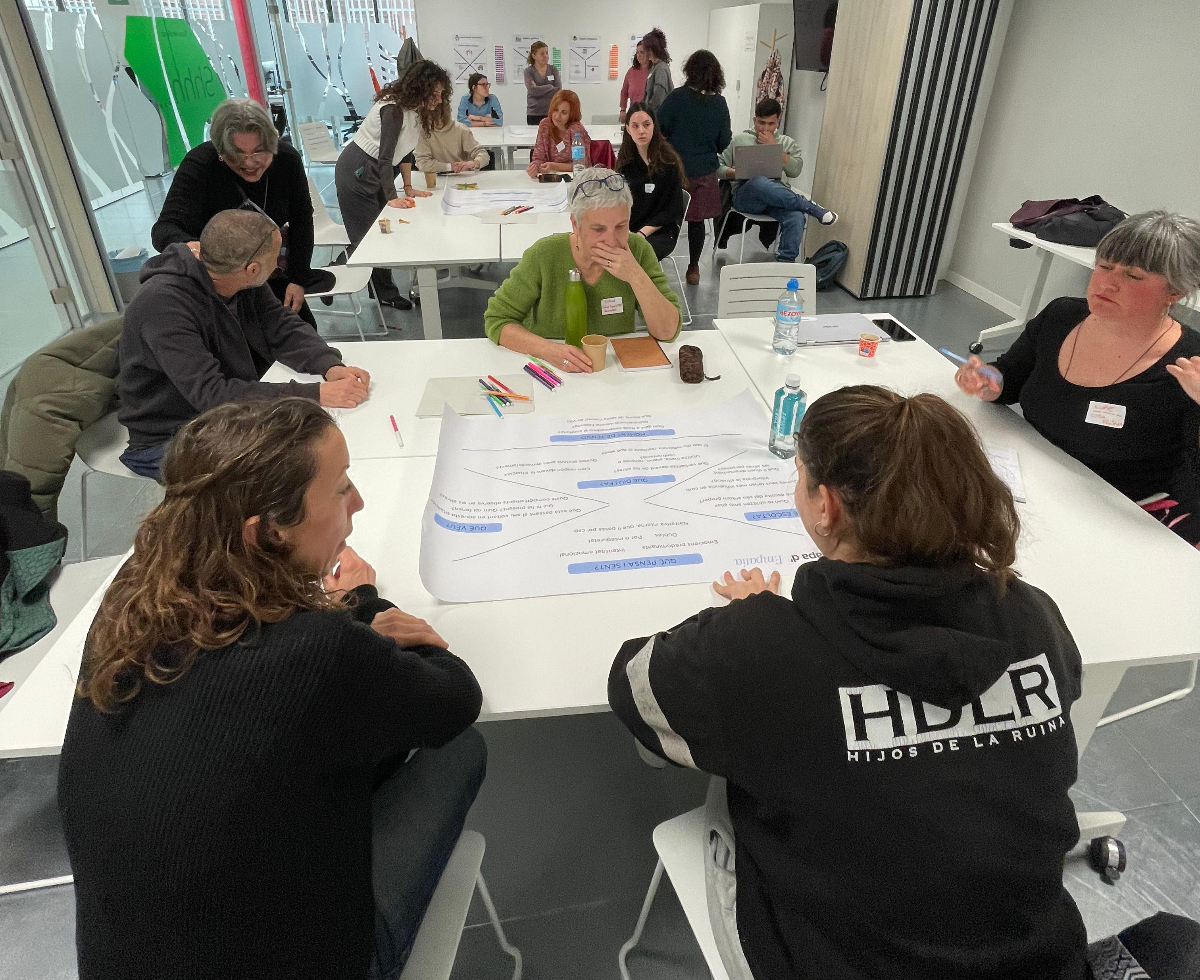
However, at Suara Cooperativa we are aware that the sum of efforts multiplies and helps us create more robust and effective responses, which is why intercooperation is the basis of our line of action. That's why we didn't want to create these virtual reality experiences alone and, recently, we organized the hackathon "Under the Skin LGTBIQ+", a co-creation space in which more than twenty professionals from Suara Cooperativa from different services for all walks of life participated, as well as survivors of LGTBI-phobic violence and members of civil organizations.
"When organizations, professionals and people who have suffered this situation, in this specific case LGTBI-phobia, participate, we end up incorporating different perspectives and very experiential parts that are not collected from the offices", points out Alonso.
In the hackathon, through different dynamics led by the Coolthinkers team from Suara Cooperativa, the participants worked together to imagine and define different situations of LGTBI-phobic violence that can then be transferred to virtual reality experiences. Based on shared experiences, the professional perspective and the contribution of the entities, scenes and stories were built designed to help adolescents and young people put themselves in the shoes of those who suffer these attacks.
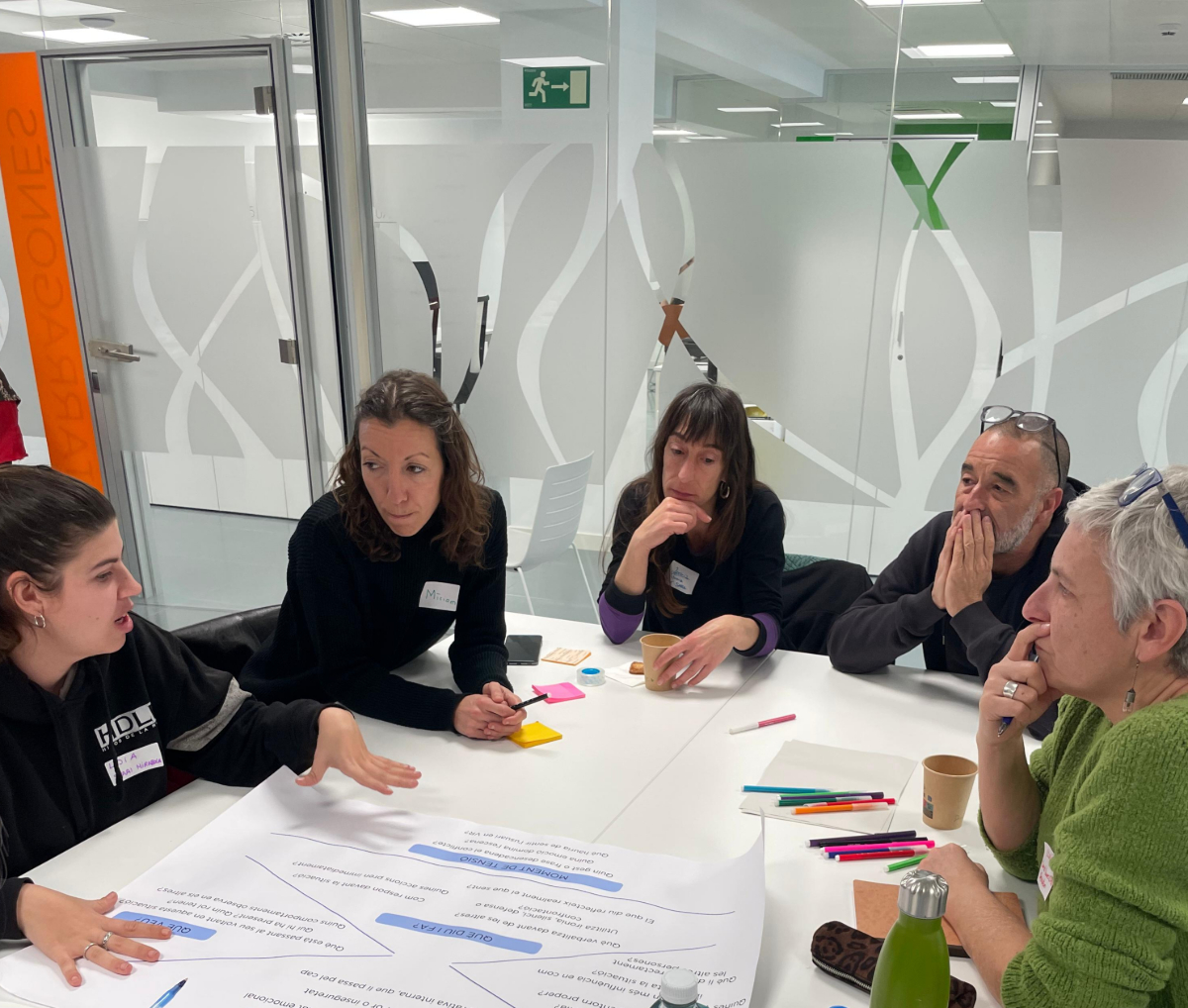
During the day, experiences were put on the table that can take place in very different spaces, such as the street, educational centers or social environments, with the aim of recreating everyday situations and making visible the emotional impact they have on the victims. All this, from a safe environment that favors reflection, debate and awareness-raising.
One of its participants was Lluïsa Fernández, coordinator of policies for Lesbian, Trans and Bisexual (LBT) women at the Observatory Against LGBTI-phobia and a psychologist, who highlights the “destructive impact” that these attacks have on victims: “It affects emotionally, cognitively, somatically, socially. The impact is 360º and, in addition, it is very subtle and constant because it has nothing to do with what the person does, but with how they are”.
In light of this, Fernández satisfactorily assesses the dynamics of the hackathon for its diversity of perspectives and expertise; while emphasizing the benefits of virtual reality for dealing with LGBTI-phobia. “It is a fairly faithful reproduction of scenarios that can be real, but in a safe environment. Therefore, the person can experience sensations, thoughts and emotions very similar to a real environment, but in a safe environment that then gives rise to reflection and discussion”, she argues.
Fanny Vidal, who was also present at the hackathon, sees its results with positive eyes: “Everything that is education, education, education and visibility is the best weapon we have so that our society advances and is more permissive and we are better as humans.”


