

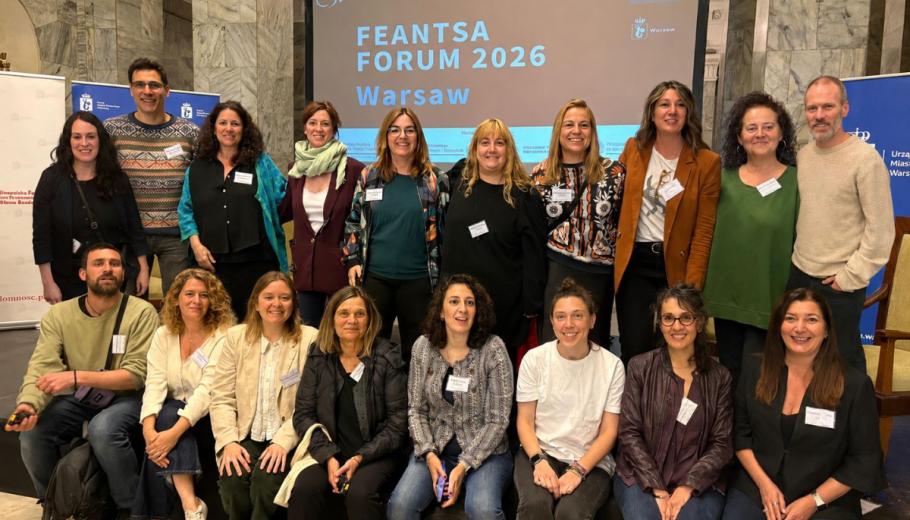


At the annual meeting, held this year in Warsaw, the results of a homelessness count conducted in 15 European cities, including Barcelona, were also presented.
Housing challenges for people experiencing homelessness were among the main topics discussed at the recent meeting of the European Federation of National Organisations Working with the Homeless (FEANTSA), held in Warsaw and attended by Suara Cooperativa.
In this context, Europe’s leading homelessness network stressed that policies aimed at tackling homelessness are not currently a priority for the European Union. At the same time, there appears to be a policy shift towards the construction of large temporary shelters rather than the provision of stable and dignified housing solutions.
Another issue highlighted was the EU’s concern about the growing number of people facing difficulties in accessing housing, with proposed measures focusing on the rapid construction of new housing and the renovation of existing spaces.
FEANTSA also expressed concern about new migration policies and the rights of LGBTIQ+ communities, which are increasingly being affected by more conservative and restrictive approaches, creating a risk of underfunding. Regarding migration policies, concerns were raised about plans to establish large accommodation facilities for migrants outside EU territory, strengthen controls on movement between EU countries, and deploy specialised agents to manage migration flows.
For this reason, organisations within the network, including Suara Cooperativa, called on FEANTSA to continue advocating for housing-focused approaches such as Housing Led projects and the Housing First programme. These initiatives are based on the principle that, for a person to rebuild their life and move away from homelessness, the first requirement is access to safe and stable housing.
Anna Garcia, Director of the Primera Llar (Housing First) service in Barcelona, operated by the Suara–Pere Claver Group joint venture and established ten years ago, attended the FEANTSA meeting as a representative of the cooperative. “Each person has lived through different experiences and therefore requires different timeframes and rhythms to build a life project. These are long-term processes that temporary accommodation cannot adequately support. What is needed is a long-lasting solution, namely access to stable housing,” Garcia explained.
The organisations also expressed concern about the rise of far-right political movements across the European Union and the impact this is having on people experiencing homelessness. Another issue raised was the increasingly hostile environment in which third-sector organisations are having to operate, particularly in their dealings with public administrations.
In addition, FEANTSA member organisations voiced concern about new migration policies that reflect an increasingly conservative approach.
European Count of People Experiencing Homelessness
Beyond these discussions, during the meeting held on 18 and 19 May, FEANTSA presented the results of a homelessness count conducted across 15 European cities, including Barcelona, the only city in Spain included in the study. The aim of this first joint initiative is to identify common indicators and data that can be compared across countries and used for Europe-wide analysis.
In Barcelona, for example, the data included in the report relate to 2024, when 1,245 people were recorded sleeping rough on a single night—74% more than a decade earlier, when the figure stood at 716. During the same period, the number of places available in public shelters increased by 97.11%, rising from 1,451 to 2,860, while the proportion of people with foreign nationality increased from 45% to 72%.
The purpose of the study is to collect comparable data across different countries in order to provide an overall picture of homelessness within the European Union. Such information would help support the development of coordinated policies to address this issue at a European level.


